
Play Le Santa Now!
Home → Strategy
Le Santa Strategy
Approaching Le Santa sensibly
Hacksaw Gaming released Le Santa in 2025 as a medium volatility slot with a 96.14% RTP, which establishes a theoretical house edge of 3.86%. This percentage represents the long-term average return over hundreds of thousands of spins, rather than a guarantee for any single session or short play period. Beginners must understand that this mathematical model dictates the expected loss rate over time, requiring patience and realistic expectations for their bankroll management.
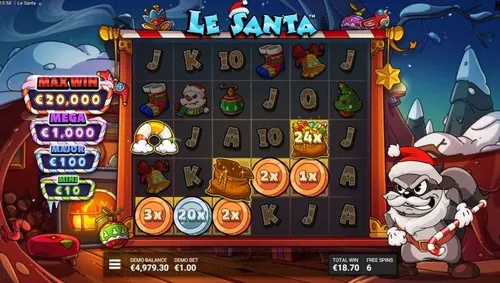
The game utilizes a 6x5 grid layout featuring Cluster Pays mechanics, allowing wins to form through adjacent symbol groups rather than fixed paylines. This structural design influences hit frequency and payout distribution, creating a different risk profile compared to traditional line-based slots. Players should adjust their strategy to accommodate these specific mechanic requirements when planning their initial approach to the title.
Le Santa offers a maximum win potential of 20,000x the stake, which is identical to other titles like Le King and Le Zeus from the same developer. However, the casino also circulates configurable low-RTP versions with returns of 94.18%, 92.25%, and 88.25%, significantly increasing the house advantage. Always verify the active RTP configuration before playing to ensure you are engaging with the intended 96.14% theoretical return version.
Bankroll rules that hold up
The minimum bet starts at 0.10 while the maximum allowed stake reaches 50 per spin, defining the absolute boundaries for your total bankroll allocation. A player setting aside 500 for flat betting can endure approximately 2,500 spins at the lowest stake level against the 3.86% house edge. This duration provides sufficient data points to observe the medium volatility behavior without risking rapid depletion of funds during dry streaks.
Progressive staking systems that raise stakes after losses do not alter the built-in 3.86% edge and only accelerate the time to ruin for the gambler. For instance, doubling a 0.10 stake after each loss quickly escalates the required capital beyond reasonable limits within a few consecutive losing rounds. Maintaining a flat betting approach preserves the bankroll longer, allowing the statistical variance to smooth out over a larger number of spins.
Comparing Le Santa to Wanted Dead or a Wild reveals distinct bankroll implications due to the latter's high volatility and 12,500x max win cap. High volatility games typically require a larger reserve to withstand longer periods without significant payouts, whereas Le Santa's medium volatility offers more frequent, smaller wins. Adjusting the initial deposit size based on this volatility difference ensures sustainable play sessions without unnecessary financial strain for the beginner.
The welcome bonus terms often impose wagering requirements that interact directly with the chosen stake size and game contribution rates. While the specific bonus structure is external, the 96.14% RTP suggests lower contribution efficiency for some operators compared to higher RTP games. Verify how slot contributions apply to the bonus turnover calculation to prevent unexpected restrictions on withdrawing winnings derived from the promotional funds.
Bet sizing against volatility
Medium volatility in Le Santa strikes a balance between risk and reward, suggesting a stake size that allows for extended play without excessive exposure. Setting bets at the lower end of the 0.10 to 50 range helps mitigate the impact of variance during inevitable cold streaks. This conservative approach aligns with the 96.14% RTP by ensuring the bankroll survives long enough to potentially trigger the 20,000x max win feature.
High volatility alternatives like Wanted Dead or a Wild demand larger bet sizing relative to the bankroll to absorb deeper drawdowns during non-paying spins. Since Le Santa distributes wins more frequently due to its medium volatility classification, players can afford slightly higher stakes while maintaining the same risk tolerance. The 6x5 cluster grid supports this dynamic by offering multiple ways to form winning combinations on each spin cycle.
The configurable RTP settings introduce variability into the expected value, meaning bet sizing must account for the specific version being played. If encountering an 88.25% RTP version, the effective house edge jumps significantly, requiring stricter budget controls to prevent rapid fund erosion. Always confirm the active configuration before adjusting stake levels, as the mathematical expectation changes drastically across the 96.14%, 94.18%, 92.25%, and 88.25% options.
Flat betting remains the most reliable method for managing bet sizing against volatility, avoiding the mathematical pitfalls of progressive systems. By keeping the stake constant at a manageable level, such as 0.50 or 1.00, players maintain control over their session duration and loss limits. This discipline prevents the emotional decision-making that often leads to oversized bets during hot or cold streaks, preserving the bankroll for future sessions.
Session limits worth setting
Establishing a strict loss limit based on the 0.10 to 50 bet range prevents emotional decision-making when facing the 3.86% house edge. A recommended limit might be 20 times the average stake, ensuring that a typical session does not deplete the entire allocated bankroll. This threshold respects the medium volatility nature of Le Santa, allowing for normal variance without triggering catastrophic financial outcomes for the player.
Time-based limits complement financial caps by preventing fatigue-induced errors during extended play on the 6x5 grid interface. Setting a two-hour session limit encourages regular breaks, helping players maintain focus on the strategic aspects of bankroll management. This discipline is particularly important given the 20,250x max win potential, which can tempt players to extend sessions beyond rational boundaries in pursuit of large payouts.
Win goals should be defined relative to the initial deposit, such as stopping play upon achieving a 50% profit increase on the starting bankroll. Securing profits early protects against the regression to the mean inherent in all slot games with a negative expected value. This strategy aligns with the 96.14% RTP by locking in gains before the mathematical edge erodes the temporary surplus created by favorable variance.
Deposit limits imposed by the casino operator provide an external safeguard that reinforces personal session boundaries and responsible gambling practices. These hard caps prevent overspending regardless of internal willpower, ensuring that the 0.10 to 50 stake range never exceeds pre-approved financial limits. Integrating these technical controls with personal stop-loss rules creates a robust framework for sustainable engagement with Le Santa and similar titles.
Why chasing losses fails
Chasing losses in Le Santa ignores the immutable 3.86% house edge, which guarantees that the casino retains its advantage over any volume of spins. Increasing stakes after a losing streak does not change the underlying probability of cluster formations on the 6x5 grid, merely accelerating the depletion of the bankroll. This mathematical reality renders any recovery strategy futile against the long-term statistical expectation of the game.
The medium volatility of Le Santa means that prolonged periods without significant wins are statistically normal and expected within the 96.14% RTP framework. Attempting to recover deficits by raising bets from 0.10 to 50 exposes the player to extreme variance that rarely favors the gambler. Such aggressive tactics violate basic bankroll management principles and transform a manageable session into a rapid financial drain.
Comparative analysis with high volatility titles like Wanted Dead or a Wild highlights why chasing is even more dangerous in Le Santa's context. While high volatility games offer larger jackpots, they also feature longer dry spells, making loss recovery attempts equally ineffective but more costly. The 20,000x max win potential requires sustained patience, not reactive betting, to materialize, rendering chase strategies mathematically unsound.
The existence of configurable low-RTP versions (94.18%, 92.25%, 88.25%) further penalizes impulsive betting behaviors by increasing the speed of fund erosion. Playing these variants while chasing losses compounds the disadvantage, as the higher house edge accelerates the decline of the remaining balance. Recognizing this multiplier effect underscores the necessity of adhering to predefined limits rather than reacting emotionally to outcome variance.
Le Santa: key facts
| Parameter | Value |
|---|---|
| Game | Le Santa |
| Studio | Hacksaw Gaming |
| Released | 2025 |
| RTP | 96.14% |
| House edge | 3.86% |
| Volatility | medium |
| Max win | 20000x |
| Reels | 6x5 grid |
| Paylines / ways | Cluster Pays |
| Bet range | 0.10 – 50 |
Common systems and their limits
Le Santa features a maximum win cap of 20,000x, which restricts the potential payout regardless of betting patterns. This ceiling applies to the base game mechanics and remains fixed across all volatility settings. Players cannot exceed this limit even during extended winning streaks. The cap ensures that the casino's liability is bounded.
The slot utilizes a Cluster Pays mechanic on a 6x5 grid layout instead of traditional paylines. This structure requires adjacent matching symbols to form wins rather than aligning them on lines. Such a design changes how players evaluate symbol proximity. It removes the predictability of linear alignments.
Hacksaw Gaming developed Le Santa with configurable RTP versions including 94.18%, 92.25%, and 88.25%. These lower configurations reduce the theoretical return significantly compared to the standard 96.14% version. Operators may deploy these variants depending on market regulations. The variance in return rates impacts long-term bankroll management.
Flat betting explained
Flat betting involves wagering the same stake amount every round throughout the session. This approach maintains a constant risk exposure per spin regardless of previous outcomes. For Le Santa, stakes range from 0.10 to 50 per spin. Consistency allows for predictable bankroll depletion rates. It prevents rapid losses associated with escalating bets.
The minimum bet of 0.10 allows for extended play sessions with limited funds. At this rate, a player can sustain more spins before exhausting their bankroll. This strategy minimizes the impact of short-term volatility swings. It does not alter the built-in house edge of 3.86%. Discipline is required to maintain the fixed stake.
Maximum stakes reach 50 per spin, increasing the absolute risk per outcome. High rollers might prefer this level to chase larger cluster wins quickly. However, the variance accelerates bankroll reduction at higher levels. The 20,000x max win potential remains accessible at any valid stake. Risk management dictates the optimal entry point.
Progressive staking risks
Progressive staking raises stakes after losses to recover deficits through subsequent wins. This method increases exposure during losing streaks without changing the mathematical expectation. In Le Santa, medium volatility means losing runs can last several spins. Escalating bets during these periods depletes funds faster. The house edge remains constant at 3.86%.
The theoretical return of 96.14% applies over hundreds of thousands of spins. Short-term progressive strategies cannot override this long-run average. Players often misinterpret medium volatility as frequent small wins. Raising stakes based on recent history ignores independence of events. Ruin probability increases with aggressive progression. The system fails under statistical law.
Comparable titles like Le Viking offer a 10,000x max win with similar volatility profiles. These alternatives do not mitigate the risks inherent in progressive betting. Le Bandit shares the same studio origin but retains identical mathematical constraints. No variant eliminates the possibility of rapid bankroll exhaustion. Mathematical edges favor the operator regardless of stake adjustment.
What the maths actually allows
The house edge of 3.86% derives from the standard 96.14% RTP configuration. This percentage represents the expected loss per unit wagered over infinite time. For every 100 units bet, approximately 3.86 units are retained by the operator. This figure defines the long-term cost of play. It excludes promotional bonuses or free spins value.
Medium volatility indicates moderate frequency and size of payouts in Le Santa. Wins occur regularly but vary in magnitude across the 6x5 grid. Cluster Pays mechanics distribute outcomes differently than line-based slots. Players should expect fluctuating session results within this variance band. Predictability is limited to statistical averages. Short-term deviations are normal.
Other Hacksaw Gaming releases such as Duel at Dawn feature high volatility with a 15,000x max win. Le Santa’s 20,000x cap offers higher potential but with medium variance. This combination suggests fewer extreme highs than high-volatility titles. The 88.25% RTP version drastically reduces expected returns. Understanding these differences aids realistic expectation setting.
Reading variance honestly
Variance describes the dispersion of outcomes around the mean return in Le Santa. Medium volatility implies a balanced distribution of win sizes and frequencies. Players will experience both dry spells and moderate winning clusters. This pattern differs significantly from high-volatility games like Alles Spitze. The latter has a 500x max win and high variance. Expectation management relies on recognizing this profile.
The 20,000x maximum win represents the upper bound of payout potential. Achieving this requires landing specific high-value clusters during bonus features. Such events are statistically rare due to the medium volatility setting. Most sessions will result in returns far below this cap. Players must accept that large wins are exceptions. Variance dictates the timeline for hitting extremes.
Configurable RTP options include versions as low as 88.25% for operator preference. These variants increase the house edge substantially beyond the standard 3.86%. Players unaware of the specific configuration face higher long-term costs. The 96.14% version offers the most favorable theoretical return. Checking the game rules reveals the active RTP. Transparency varies by jurisdiction.
Learning the game in demo first
Hacksaw Gaming released Le Santa in 2025 as a 6x5 grid slot using Cluster Pays mechanics, allowing players to test the layout without financial risk. This specific reel structure differs from the standard 5x3 grids found in titles like Book of Dead by Play'n GO or Big Bass Splash by Pragmatic Play. Beginners can observe how symbols connect horizontally and vertically before committing real funds to any spin.
The theoretical return to player (RTP) is set at 96.14%, representing the average percentage returned over hundreds of thousands of spins rather than short-term results. Some configurations circulate with lower returns of 94.18%, 92.25%, or 88.25%, which increases the house edge significantly for the operator. Understanding this variance helps new players recognize that the displayed percentage does not guarantee immediate payouts during a single session.
Le Santa features medium volatility, meaning wins occur with moderate frequency compared to high-variance games like The Dog House Megaways. This balance prevents rapid bankroll depletion while still offering substantial payouts up to 20,000x the stake. Testing the demo mode reveals how often these clusters form without the pressure of losing actual money on every attempt.
Adjusting stakes to your budget
The betting range spans from 0.10 to 50 per spin, providing flexibility for different bankroll sizes and playing styles. A flat betting strategy involves maintaining the same stake every round, which simplifies tracking losses against the total bankroll. This approach avoids the risks associated with progressive staking, where raising bets after losses only accelerates the time to ruin.
With a maximum win cap of 20,000x, even a minimum bet of 0.10 can theoretically yield 2,000 in a single cluster combination. However, hitting such high multipliers is statistically rare due to the medium volatility settings inherent in the game design. Players should calculate their total potential loss based on the upper limit of 50 per spin if they choose to wager aggressively.
Comparing Le Santa to Wild Bounty Showdown by PG Soft highlights differences in reel layouts, as the latter uses a diamond-shaped formation. Le Santa’s 6x5 grid offers more opportunities for symbol interactions within its Cluster Pays system compared to traditional payline slots. Adjusting stakes requires understanding how the grid size influences the probability of forming winning combinations across adjacent symbols.
Recognising a bad session
A session becomes problematic when the bankroll depletes faster than expected due to consecutive non-winning spins or small cluster payouts. Since Le Santa has no cash-out button and is strictly a slot, players cannot stop mid-feature to preserve remaining funds once a bonus round begins. Recognizing this limitation helps beginners avoid chasing losses through irrational betting patterns during extended play.
The house edge of 3.86% ensures that over time, the casino retains a portion of all wagers regardless of short-term wins. If a player experiences a streak of losses exceeding their predetermined limit, continuing to play increases the likelihood of total bankroll exhaustion. Setting a strict loss limit before starting aligns with responsible gambling principles and prevents emotional decision-making.
Unlike crash games or table games with strategic elements, Le Santa relies entirely on random number generation for every spin outcome. There are no skill-based decisions to influence the result, making it impossible to recover losses through gameplay adjustments alone. Identifying when to walk away depends on recognizing that each spin is independent and unaffected by previous outcomes.
Stopping while ahead
Cashing out profits early preserves gains that might otherwise be lost to the house edge during continued play. Since Le Santa allows a maximum win of 20,000x, securing a portion of this amount after achieving a significant cluster payout reduces exposure to variance. This strategy contrasts with waiting for an eventual jackpot, which statistically favors the operator over the long run.
Many online casinos offer welcome bonuses like 300% up to €2,000 plus 100 free spins, but these come with wagering requirements that must be met before withdrawal. Playing Le Santa with bonus funds requires careful monitoring of contribution rates, as some games may count differently toward clearing these conditions. Stopping after meeting key milestones ensures compliance with terms while retaining eligible winnings.
Comparing Le Santa to Zeus vs Hades by Pragmatic Play shows similar max win potentials but different volatility profiles affecting win distribution. Leaving the game after hitting a substantial multiplier prevents reinvesting profits into subsequent spins that carry the same negative expectation. Discipline in stopping while ahead transforms temporary luck into realized financial gain rather than hypothetical future earnings.
Responsible play in practice
Setting daily loss limits and time restrictions helps maintain control over gaming habits and prevents excessive spending beyond one’s means. Le Santa’s medium volatility and fixed RTP mean outcomes cannot be predicted or manipulated through external systems or strategies. Adhering to pre-defined boundaries ensures that entertainment remains affordable and does not interfere with personal finances or responsibilities.
Self-exclusion tools and deposit limits provided by operators serve as essential safeguards against compulsive gambling behaviors linked to slots like Le Santa. These measures allow players to pause activity temporarily or permanently if they notice signs of problematic engagement with the game mechanics. Utilizing these resources demonstrates proactive management of risk rather than reactive damage control after significant losses occur.
Educating oneself about terms such as RTP, volatility, and house edge empowers players to make informed decisions about their participation in Le Santa. Understanding that the 96.14% return is a theoretical average over millions of spins clarifies why short-term results vary widely from expectations. Responsible play involves accepting randomness as an inherent feature of slot games and prioritizing enjoyment over profit maximization.
DemoRTP & VolatilitySymbols & PayoutsBonus FeaturesStrategyBonusesMobileDownload & AppMax WinSimilar GamesReviewFAQSitemap
Le Santa 2026